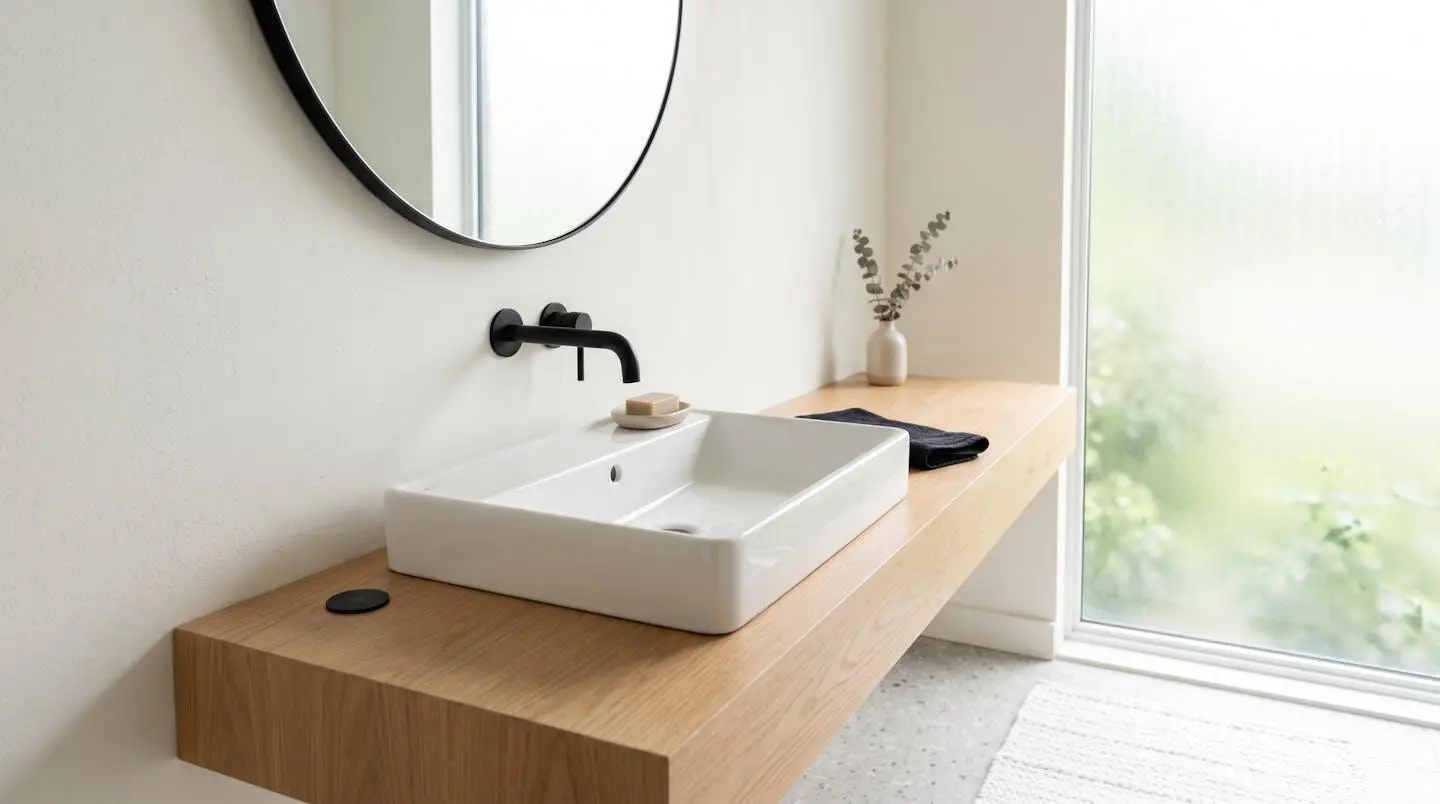
Renovating a kitchen or bathroom in 2026 means navigating a market where fixtures have quietly become one of the most impactful design decisions you can make. Beyond aesthetics, the shift toward smarter, more water-conscious hardware is reshaping what Ontarians expect from their living spaces — and what adds real, lasting value to a home.
- Touchless faucets: hygiene meets everyday convenience
- Water-efficient fixtures: saving more than just water
- Statement finishes: matte black, brushed gold, and beyond
- Smart shower systems: precision comfort at every use
- Integrated water treatment at the fixture level
- Before you start: your renovation readiness checklist
Touchless faucets: hygiene meets everyday convenience
The appeal of sensor-activated taps has moved well beyond commercial washrooms. In residential settings across Guelph and Waterloo Region, touchless faucets are increasingly specified for both bathrooms and kitchens — and the reasoning is straightforward. A hands-free faucet eliminates the single most common contamination point at a sink: the handle itself.
What changed the calculus for homeowners is not just the technology, but the form factor. Current sensor faucets are slim, architecturally refined, and available in finishes that complement any cabinet palette. The underlying mechanism — typically an infrared proximity sensor tied to a solenoid valve — responds within milliseconds, and modern versions include manual override modes that remove the frustration of accidental activation. Fitting a plumbing fixture installation for a sensor-based faucet into an existing under-sink layout is now far more standardized than it was even three years ago. Homeowners and property managers can better understand the different installation requirements, compatibility considerations, and setup steps by consulting this page.
Battery-powered models eliminate the need for an electrical connection entirely, which simplifies retrofits in older homes where running a new line to the vanity would otherwise add significant time and cost to a project.
Conseil pro : When selecting a touchless kitchen faucet, verify that the sensor field is adjustable. A fixed-range sensor positioned too close to a deep farmhouse sink will trigger constantly; one set too far will require exaggerated hand movement to activate.
Consider a scenario familiar to many families with young children: a bathroom faucet with a handle that gets soap-covered multiple times a day, requiring daily scrubbing of the hardware itself. Switching to a sensor tap removes that maintenance burden entirely while teaching water-saving habits organically — the flow simply stops the moment hands move away.
Water-efficient fixtures: saving more than just water
Water efficiency has crossed from a niche specification into a mainstream renovation expectation. The evidence bears this out: according to Statistics Canada‘s data on household water use, the residential sector accounts for a substantial share of municipal water demand, and kitchen and bathroom fixtures represent the highest-frequency draw points in any home. Reducing flow rates at those two locations produces the most consistent savings over time.
2.8%
Annual increase in Canadian residential renovation activity, reflecting growing investment in modern plumbing upgrades
The current benchmark for a high-efficiency kitchen faucet sits around 1.5 gallons per minute — down from the older standard of 2.2 GPM. For showerheads, WaterSense-equivalent products deliver a satisfying pressure experience at 1.75 GPM or less, achieved through pressure-compensating aerators that introduce air into the stream without perceptible reduction in rinse effectiveness.
Low-flow toilets have undergone their own quiet revolution. Dual-flush models allow users to choose between a reduced flush for liquid waste and a full flush for solids, with the reduced cycle typically using under 0.8 gallons. Over a year in a household of four, that difference compounds into thousands of litres of water conserved without any behavioural change required beyond pressing the correct button.
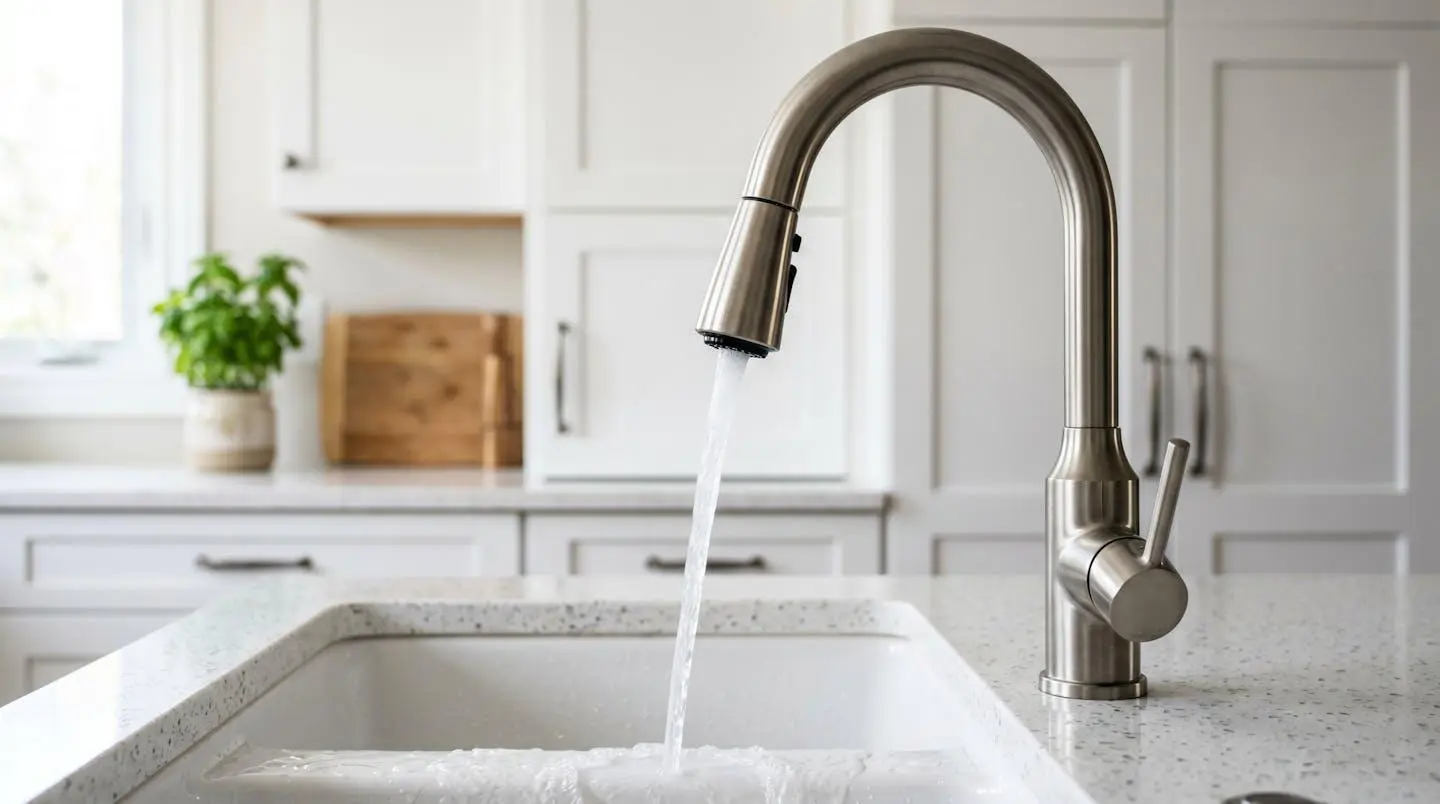
The financial argument reinforces the ecological one. Replacing older, high-consumption fixtures with certified efficient alternatives typically falls within a budget homeowners can recoup through reduced water and heating bills over a period that aligns well with a standard renovation cycle.
Statement finishes: matte black, brushed gold, and beyond
For years, chrome held an almost unconditional monopoly over plumbing hardware. That era has ended. Matte black, brushed brass, gunmetal, and warm champagne bronze now occupy equal shelf space in plumbing showrooms, and their presence in renovation projects has shifted from accent choice to primary design language.
The practical case for matte finishes is stronger than it might appear. Polished chrome telegraphs every water spot and fingerprint within hours of installation — an ongoing maintenance reality that matte surfaces neutralize almost entirely. Matte black in particular hides mineral deposits and light surface scratches, making it a more forgiving choice in areas with harder municipal water.
Practical scenario: mixing metal finishes in one bathroom
Consider a bathroom where the homeowner pairs a brushed gold faucet with matte black towel bars and a chrome-trimmed mirror. The risk of visual confusion is real, but the practice demonstrates a deliberate layering of warm and cool tones that design professionals call « collected » rather than « matched. » The key constraint: limit the combination to two finishes maximum within any single room, and ensure at least one is repeated across three or more hardware points to create visual continuity.
Durability varies significantly between finish types. Physical vapour deposition (PVD) coatings — the technology behind most premium matte and brushed finishes — bond at a molecular level to the base metal, producing resistance to chipping and tarnishing that far exceeds traditional electroplating. Specifying PVD-finished fixtures adds a modest premium to the initial cost but extends the maintenance-free lifespan of the hardware considerably.
Smart shower systems: precision comfort at every use
A smart shower system operates on a fundamentally different logic than a conventional valve. Rather than adjusting temperature through mechanical blending at the point of use, these systems use digital thermostatic controllers — mounted separately from the showerhead — that pre-set and hold the desired temperature before flow begins. The practical result is that water reaches the target temperature before it exits the fixture, eliminating the cold-water run-off that typically goes down the drain during warm-up.
Multiple outlet control is the other differentiating feature. A digital shower controller can manage a ceiling rain head, a handheld wand, and body jets independently or in combination, with each outlet assignable to user-specific presets. For households where different family members have genuinely different shower preferences, this translates into a noticeably more seamless morning routine.
Bon à savoir : Smart shower systems require a power connection at the valve location. Before specifying one in a renovation, confirm with your plumber that the rough-in location allows for an electrical feed — or that the tile plan can accommodate a concealed conduit run without additional drywall work.
Voice integration and app-based scheduling represent the more forward-looking end of this category. Some systems allow a shower to be started remotely so that it reaches temperature before the user enters the bathroom. Whether that level of automation is genuinely useful or merely novel depends on the household, but the thermostatic precision alone is already a meaningful functional upgrade over conventional pressure-balance valves.
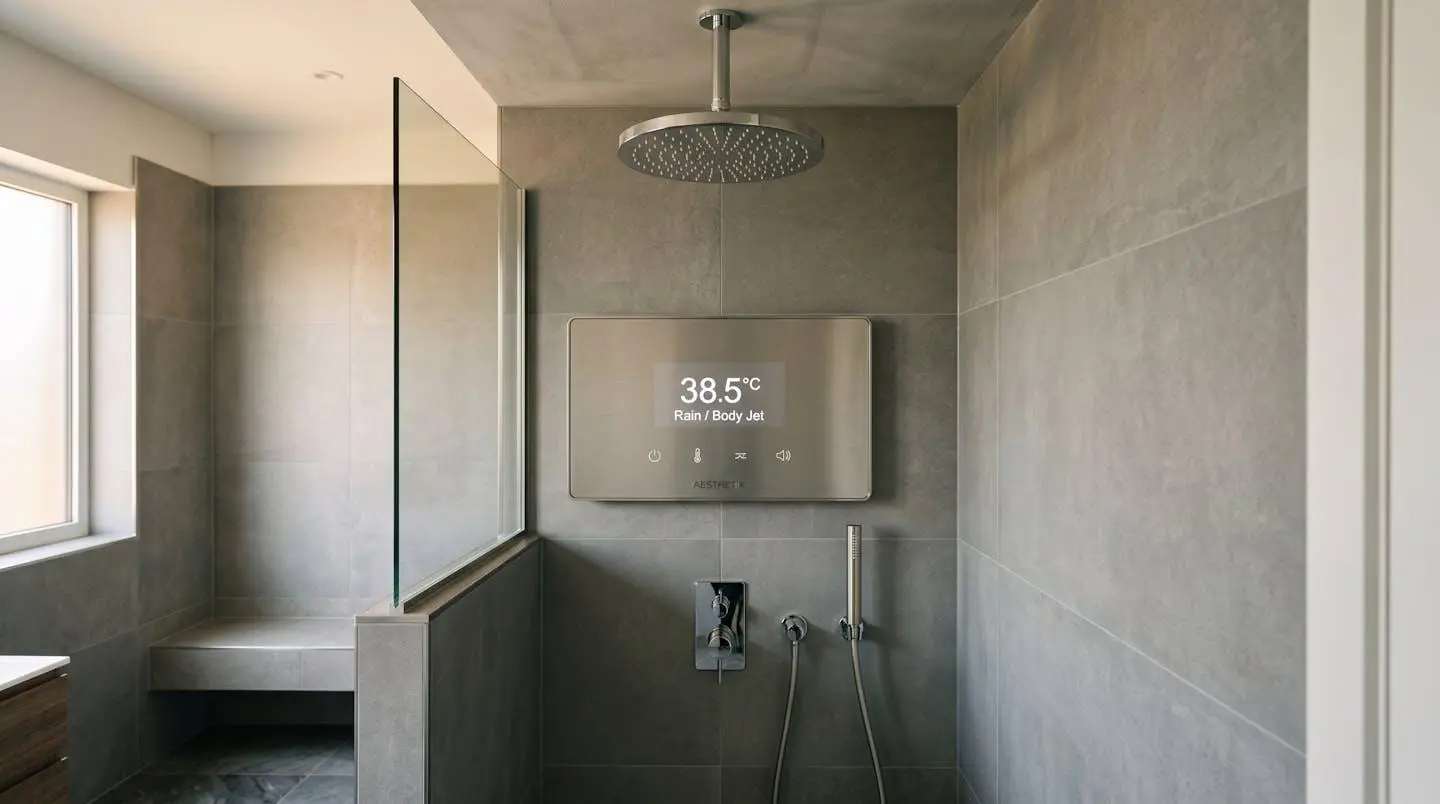
Installation for these systems is more involved than a standard valve swap, and the involvement of a licensed plumber is not optional — it is the condition under which the manufacturer warranty remains valid. The complexity, though, sits primarily in the rough-in phase; the finished product is architecturally cleaner than most traditional setups precisely because the control panel decouples from the water outlets.
Integrated water treatment at the fixture level
Point-of-use filtration built directly into kitchen faucets represents one of the more consequential shifts in residential plumbing over the current renovation cycle. Rather than routing water through a separate under-sink filter and a dedicated dispensing tap, integrated filtration faucets deliver filtered water through the same spout as standard flow — with a lever or button that switches the active filter cartridge into the line.
The relevance for Ontario homeowners is tied to the regional water quality context. Municipal water in communities served by Guelph’s water system meets provincial drinking water standards, but hardness levels and chlorine taste vary seasonally. An integrated filter targeting chlorine taste, particulates, and lead — the three most common residential concerns cited by water quality organizations — addresses those variables without the under-sink cabinet space penalty of a standalone system.
Affirmation : A whole-home water softener makes a kitchen faucet filter redundant.
Reality : A softener removes hardness minerals through ion exchange but does not filter chlorine, sediment, or potential lead from service line connections. Point-of-use filtration addresses a different set of contaminants and the two systems are complementary, not redundant. Homes with both a softener and an integrated filter faucet benefit from full-spectrum treatment at the drinking point.
Whole-home water treatment systems — softeners, UV sterilizers, sediment filters — pair logically with this fixture-level approach. The professional installation of such systems, including the connections between treatment equipment and the fixture supply lines, is precisely where plumbing installation techniques become critical to long-term performance. A poorly sealed cartridge housing or an improperly torqued supply connection will allow bypass flow that defeats the filtration purpose entirely.
Replacement cartridge cycles vary between systems but typically fall in the range of six to twelve months for household use. Some faucets include a flow-rate indicator that signals when the cartridge is approaching saturation — a practical feature that removes the guesswork and prevents homeowners from running degraded filtration without realizing it.
The broader category of water-aware plumbing also connects to a documented uptick in demand for water treatment products across Canadian households. Homeowners pursuing phased renovation approaches increasingly cite water treatment integration as one of the higher-return incremental improvements available for projects that span multiple phases rather than a single full gut renovation.
Before you start: your renovation readiness checklist
Translating trend awareness into a functional renovation plan requires a few concrete preparatory steps. The gap between seeing a fixture in a showroom and having it perform correctly in your home is bridged almost entirely by the quality of the installation decision-making that precedes the physical work. Skipping this groundwork is where the most avoidable renovation frustrations originate — not in the products themselves.
The projects that consistently stay on budget and achieve the intended aesthetic outcome are those where fixture selection happens after, not before, the plumber has assessed the existing rough-in configuration. That sequencing prevents the common scenario where a homeowner specifies a wall-mounted faucet only to discover that the supply lines are floor-fed and repositioning them doubles the projected labour cost.
- Confirm your existing rough-in dimensions (centre-to-centre for faucet holes, drain rough-in height for toilets) before ordering any fixture
- Check whether smart shower or sensor faucet models require an electrical connection near the planned valve location
- Verify that your home’s water pressure is within the rated operating range for any thermostatic or high-efficiency fixture you are considering
- Select finishes after confirming what adjacent hardware (cabinet pulls, lighting fixtures, towel bars) will remain unchanged — avoid specifying a finish you cannot replicate across all visible metal points
- Engage a licensed plumber for the installation assessment before finalizing your fixture selection — not after
The five trends covered here — sensor faucets, water-efficient hardware, PVD statement finishes, smart shower systems, and integrated filtration — represent a coherent upgrade path rather than a wish list. Each addresses a real functional gap in how older plumbing hardware performs, and each has reached a maturity level where product reliability and installation standardization make them practical choices for a renovation happening today, in a home like yours, in a market like Ontario’s. The question worth sitting with is not whether these upgrades are worth pursuing — the data consistently suggests they are — but which one addresses your most immediate daily friction point and is worth acting on first. That answer shapes everything else. You can also understand modern trends in related lifestyle renovation contexts to build a fuller picture of where residential design is headed.
Are touchless faucets difficult to install in an existing bathroom?
Most touchless faucets designed for residential use are engineered to fit standard three-hole or single-hole sink configurations. Battery-powered models require no electrical rough-in work at all. The swap is typically comparable in complexity to replacing a conventional faucet, provided the valve body fits the existing sink deck cutout. A licensed plumber can confirm compatibility during a pre-installation assessment.
Do matte black fixtures show more wear than polished chrome over time?
PVD-coated matte black fixtures are engineered specifically for long-term durability in wet environments. They resist scratching and tarnishing considerably better than electroplated finishes. The key is specifying PVD-finished hardware rather than powder-coated alternatives, which are less resistant to the humidity and cleaning agents present in a bathroom or kitchen environment.
Is a smart shower system worth the additional cost in a standard residential bathroom?
The value depends on two factors: household size and renovation scope. In a bathroom being fully retiled, adding a digital thermostatic system during rough-in adds relatively modest incremental cost compared to retrofitting later. For households with four or more users and meaningfully different temperature preferences, the daily convenience argument is strong. For a single-occupant or straightforward shower configuration, a high-quality pressure-balance valve may deliver the core benefit at lower cost.